
 3 months ago
108
3 months ago
108
The BEA's April PCE print showed headline inflation at 3.8% year over year and core at 3.3%, broadly matching economist expectations and removing the risk of a fresh macro shock, leaving Bitcoin in the fragile middle ground it has occupied since losing $75,000, where macro panic has cooled.
Yet, renewed demand still has to arrive before stabilization becomes a directional move. Matt Mena, senior crypto research strategist at 21Shares, said in a note:
“Market sentiment is being anchored by today’s PCE print coming broadly in line with expectations, giving risk assets a needed macro stabilizer after a volatile stretch driven by geopolitical headlines and inflation prints.”
The PCE print confirmed Mena's read that inflation held steady at the exact moment Bitcoin was already technically fragile.
| Headline PCE inflation | 3.8% YoY | Inflation did not surprise hotter, removing a bear catalyst |
| Core PCE inflation | 3.3% YoY | Still too high for a clean Fed-cut narrative |
| Fed inflation target | 2.0% | Macro is stabilizing, not easing |
| Rate expectations | Unchanged into 2027 | BTC needs internal demand, not just liquidity hopes |
| BTC market state | Below $75K | Relief matters because Bitcoin was already technically fragile |
$80,000 as the macro confirmation line
BTC had slipped below $75,000 before the PCE data landed, registering an intraday low near $72,500 and keeping the $73,000-$75,000 support zone under pressure.
US spot Bitcoin ETFs recorded $733.4 million in net outflows on May 27, with IBIT accounting for $527.8 million of that figure, and PCE removed the risk of a hotter-than-expected print compounding that damage, while leaving the bid behind those outflows unresolved.
The 3.8% annual headline figure is the fastest pace in three years and aligns with forecasts. Markets have already priced in rates staying unchanged into 2027, meaning Bitcoin's next leg higher requires internal demand to arrive independently of monetary easing.
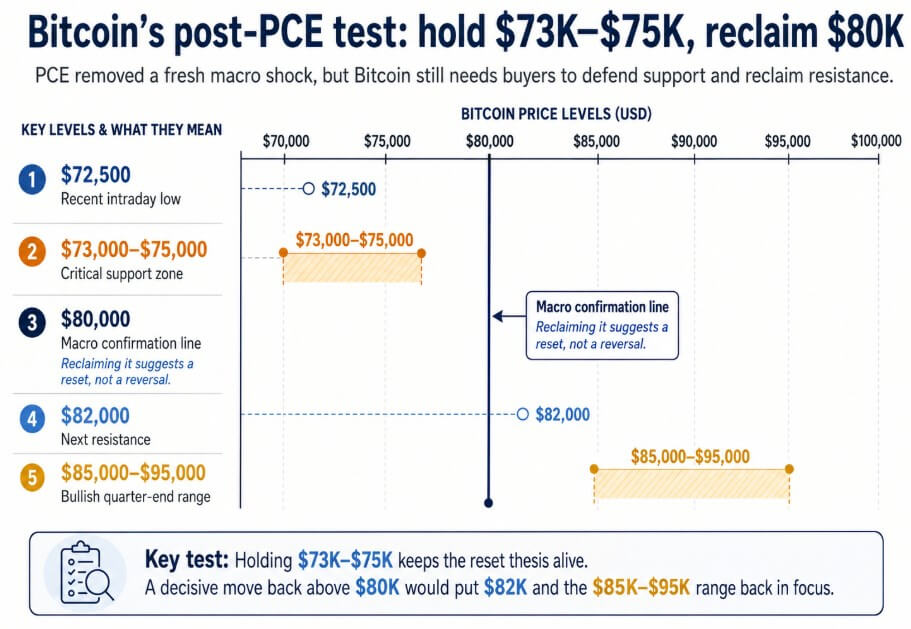 A price-level chart maps Bitcoin's five key post-PCE zones, from the $72,500 intraday low to the $85,000–$95,000 bullish quarter-end range.
Bitcoin broke above $80,000 a few weeks ago after holding below it for more than three months, the level Mena identifies as where the bull thesis confirms or stalls, and the current consolidation between $73,000 and $75,000 puts that breakout at risk of being erased.
Mena reads the move as a reset, noting that Bitcoin is up by over 10% from April's open and over 11% since the start of Operation Epic Fury, while gold has declined over 16% over the same period.
That difference reinforces Bitcoin's position as a high-beta macro asset with differentiated demand, one that held its support zone through a geopolitically charged stretch that sent more traditional safe-haven assets lower.

The bid PCE left open
A decisive reclaim of $80,000 would put $82,000 back in focus, the resistance that capped upside since February, and in Mena's model could set Bitcoin up to end the quarter in the $85,000-$95,000 range.
If Bitcoin consolidates at $73,000-$75,000, the ETF outflows slow, and BTC reclaims $80,000, the pullback resolves as a reset after an impressive run.
PCE's in-line print removed the macro trigger for a forced breakdown, and Mena's relative-strength argument is that crypto held through geopolitical volatility that pressured other assets, the broader crypto market is up roughly 6% over the same period, and Hyperliquid's HYPE token set a new all-time high of $65.
Those are telling of risk appetite across the space holding through the sell-off. Polymarket currently prices a 57% probability that the CLARITY Act is signed into law in 2026, and ceasefire diplomacy between the US and Iran has eased one of the geopolitical overhangs that drove volatility through the spring, adding secondary support to the bull case.
Mena's year-end target, contingent on inflation fears staying contained and regulatory momentum continuing, puts Bitcoin above $100,000.
If ETF redemptions continue and BTC loses the $73,000-$75,000 zone, PCE's neutral reading leaves the floor entirely to internal demand.
With inflation at 3.8% headline and 3.3% core, the Fed stays in a hold that markets have already priced through 2027, meaning Bitcoin in the bear case has only internal demand to work with.
A break below $73,000 would reframe the current consolidation as distribution and push the $80,000 reclaim further out of reach.
Policy tailwinds, such as CLARITY odds and Middle East de-escalation, stay in place, but policy momentum alone carries insufficient force to reverse a Bitcoin selloff driven by sustained spot-market outflows and deteriorating ETF demand.
| Bull case: reset confirmed | ETF outflows slow, BTC holds $73K–$75K, and price reclaims $80K | $82K comes back into focus; $85K–$95K becomes plausible | PCE relief becomes the base for another leg higher |
| Base case: fragile stabilization | BTC holds support but fails to reclaim $80K quickly | Choppy trading between support and resistance | PCE avoided a shock, but buyers still need to show up |
| Bear case: demand breaks | ETF redemptions continue and BTC loses $73K | Consolidation turns into distribution | Inflation did not break Bitcoin, but weak demand might |
Sticky inflation keeps financial conditions tight for the high-beta assets that Bitcoin most closely resembles in a risk-off environment, and tight conditions favor sellers over buyers at current support levels.
Inflation held close enough to April's forecasts to keep the macro shock risk contained, and at 3.8% headline and 3.3% core, it also confirmed that inflation remains too elevated for the Fed to ease financial conditions.
Bitcoin's next move depends on whether buyers return before the $73,000-$75,000 support gives way, and whether a reclaim of $80,000 arrives before the stabilization PCE provided runs out.