 2 months ago
127
2 months ago
127
Starknet launched strkBTC on May 12, locking BTC on Bitcoin's base layer to back an ERC-20 token that brings shielded balances into a smart contract environment at scale.
The token runs in the public mode, where it behaves like any other wrapped Bitcoin asset, and shielded mode, where users can hide selected balances and transfers from outside observers.
Starknet routes viewing keys to an independent third-party auditor, preserving selective disclosure when regulators or counterparties require it.
A five-member federation handles BTC movement between Bitcoin and Starknet, with its roadmap pointing to greater trust minimization. Atomiq and Garden provide bridge routes from BTC and WBTC into the new token.
Starknet published its privacy argument on Apr. 10, framing on-chain visibility as incompatible with real financial use.
By Apr. 20, v0.14.2 was live, with native in-protocol proof verification and the infrastructure layer for encrypted balances. On Apr. 28, Starknet confirmed that Atomiq and Garden would wire BTC and WBTC liquidity directly into strkBTC.
On May 7, it disclosed the five-member federation, and seven days later, the product went live.
That build sequence reflects that the most active Bitcoin privacy development is happening outside the Bitcoin protocol, in environments designed for rapid iteration.
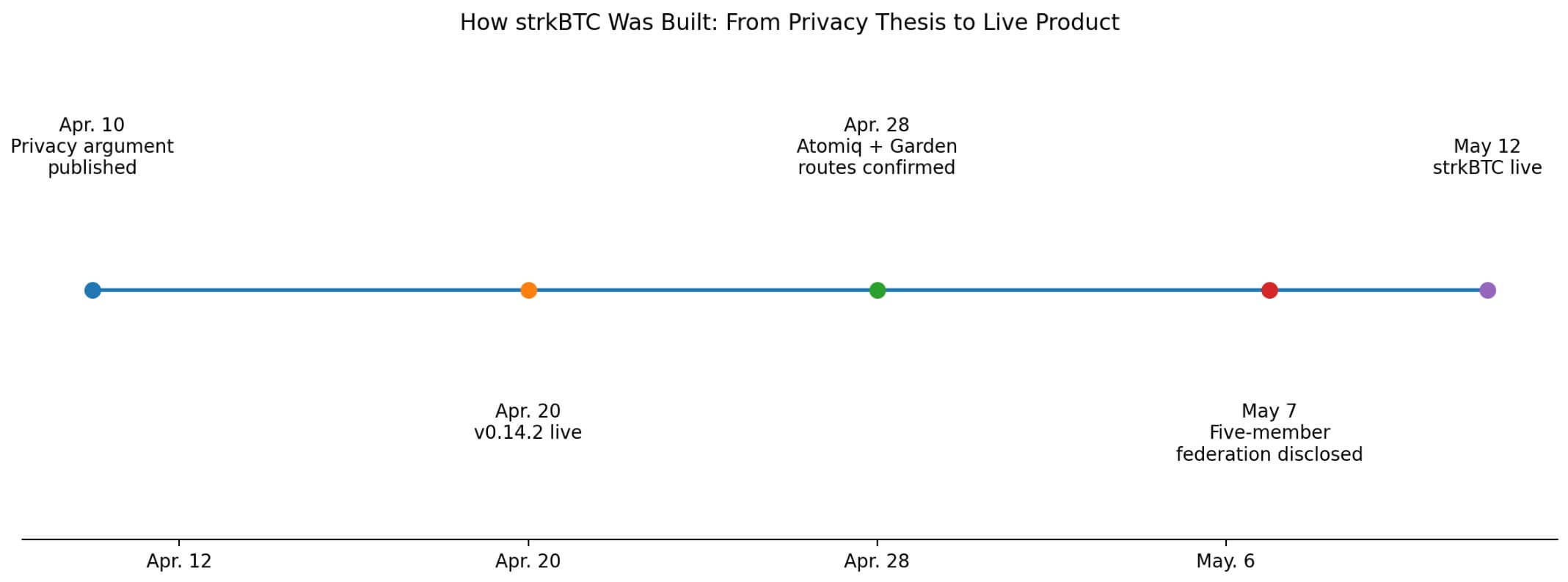 Starknet's strkBTC went from privacy thesis to live product in 32 days, crossing five development milestones between April 10 and May 12.
Bitcoin built transparency into its ledger by design. Every transaction is verifiable, every address is traceable, and the complete payment history of any wallet is visible to anyone with a block explorer.
For corporate treasury managers, large-value OTC desks, or any entity that prefers not to broadcast its full wallet balance to the market on every outbound payment, it creates a real operational problem.
The market response has been to build privacy into adjacent systems that can move faster than Bitcoin's base layer.
Private Bitcoin built elsewhere
Liquid, Blockstream's Bitcoin sidechain, has operated on this principle for years.
Users lock BTC into the peg and receive L-BTC on a network where Confidential Transactions hide both the asset type and amount from outside observers, making third-party inspection of amounts impossible.
Liquid's functionaries sign the blocks, federation infrastructure handles peg-outs, and users trade Bitcoin's security model for Liquid's in the process. Real privacy, available inside Liquid's federated architecture, with its own trust assumptions baked into every peg transaction.
WBTC paired with RAILGUN shows the same pattern in EVM territory. WBTC brings Bitcoin exposure to Ethereum, and RAILGUN shields ERC-20 assets in private 0zk balances, where users can send, swap, and interact with DeFi without those actions appearing on a public ledger.
RAILGUN requires assets to be in ERC-20 form before it can shield them. The privacy covers a Bitcoin-derived instrument that has already crossed into Ethereum, with WBTC's issuer and bridge touching the Bitcoin before RAILGUN can shield it.
Fedimint and Cashu build privacy through custody, as users deposit Bitcoin into a federated system and receive private payment claims in return.
Fedimint's federation guardians cannot trace individual members' balances or transaction histories, and Cashu uses Chaumian blind signatures, allowing users to spend privately against a mint without the mint seeing who holds what.
Both deliver genuine payment privacy, and both carry the same cost of making trust a third-party responsibility.
0xbow's Privacy Pools add a compliance layer to that same pattern, vetting deposits and providing users with zero-knowledge proofs that their funds are not connected to flagged addresses before admitting them into an association set.
That parallels Starknet's viewing-key architecture closely enough to show that selective disclosure is becoming a design standard across the sector.
What each model trades for privacy
Every solution solves a distinct problem and adds a distinct assumption.
Liquid hides amounts and asset types through Confidential Transactions, but users have accepted federation governance and peg mechanics to access that privacy. strkBTC layers a five-member federation, a bridge, smart contracts, and a third-party auditor underneath its shielded mode.
RAILGUN's DeFi privacy reaches users only once WBTC's issuer and bridge have already touched the Bitcoin, and Fedimint's strong transactional privacy inside a community mint vanishes if the federation does.
Cashu is the most transparent about its terms, offering fast private payments at the explicit cost of mint custody. Across all of them, the privacy improvement is real and attached to bridge, federation, or mint assumptions.
| Liquid / L-BTC | Hides asset type and amount through Confidential Transactions | Federation governance and peg mechanics | Users who want Bitcoin privacy inside a sidechain environment |
| strkBTC | Shielded balances and transfers in a smart-contract environment | Five-member federation, bridge, smart contracts, third-party auditor | BTCFi users and institutions seeking auditable privacy |
| WBTC + RAILGUN | Private balances, transfers, and DeFi interactions for Bitcoin-derived assets | WBTC issuer risk, bridge risk, smart-contract/privacy-layer risk | EVM DeFi users who want privacy after wrapping BTC |
| Fedimint | Strong transactional privacy inside a federated system | Federation/community custody risk | Community or local payment networks |
| Cashu | Fast, private Bitcoin-backed payments using blind signatures | Mint custody and redemption risk | Users prioritizing lightweight private payments |
| Silent Payments | Reusable payment address without onchain linkability | Minimal added trust, but narrower privacy scope | Native BTC holders who want receiver privacy without leaving Bitcoin |
Bitcoin-native privacy is advancing toward narrower goals on a longer timeline.
BIP 352, which addresses Silent Payments, lets receivers publish a single reusable off-chain address while each incoming payment lands at a unique on-chain address, removing the address-reuse linkability that makes wallet tracking straightforward.
Bitcoin Optech has documented steady progress in scanning performance and wallet integration, and the privacy gain adds almost no new trust. Users keep their BTC on the Bitcoin network, use no bridges or federations, and maintain Bitcoin's full base-layer security.
Silent Payments deliver receiver-level privacy, with each incoming payment reaching a unique on-chain address, making wallet clustering difficult and requiring no BTC movement.
The scope stops at the payment layer. Shielded portfolio balances, private DeFi execution, and concealed smart-contract interactions belong to wrapped and sidechain systems that are outpacing Bitcoin's own development.
That difference between Bitcoin-native privacy primitives and the shielded environments that wrapped and sidechain systems can build is where the market is currently filling in with external solutions.
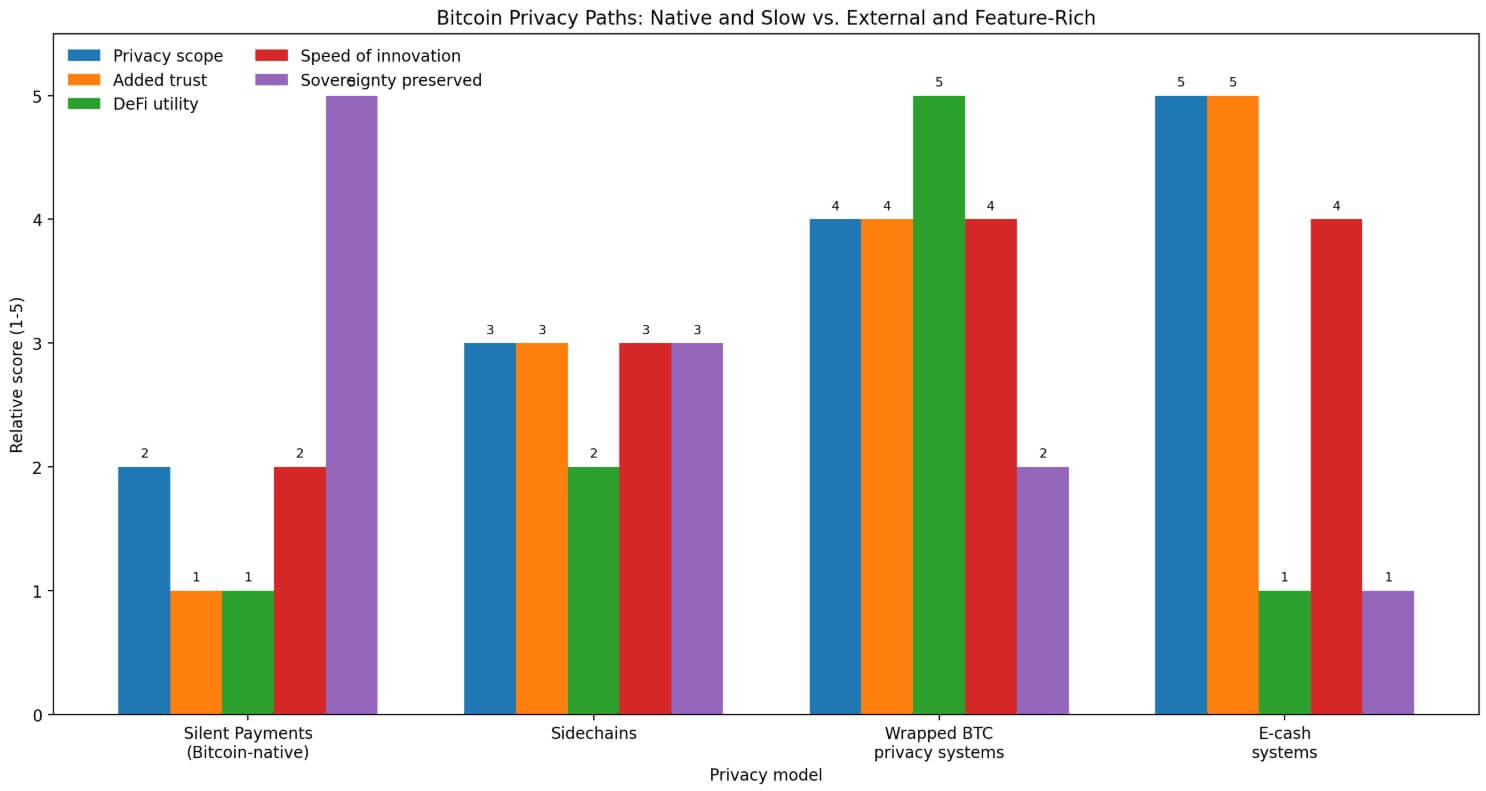 Four Bitcoin privacy models rated across five dimensions show Silent Payments leads on sovereignty while e-cash and wrapped BTC lead on privacy scope.
The bull case for strkBTC-style architectures is that auditable privacy is exactly what institutions need.
Selective disclosure through viewing keys, association sets, and view-only wallets provides compliance officers with a workable audit trail without publicly exposing every transaction.
In this scenario, wallets make shielding a one-tap option, federations mature toward trust minimization as Starknet's roadmap describes, and Bitcoin privacy becomes a competitive feature in BTCFi.
That would attract treasury managers and market makers who need transaction privacy for counterparty reasons but cannot accept opacity for regulatory ones.
The bear case is that the trust stack proves too thick. A five-member federation, a bridge, a smart contract environment, and a viewing-key auditor each introduce trust layers absent from Bitcoin's base chain.
Users who understand those layers, or who watch one of them fail, may decide the sovereignty cost exceeds the privacy gain.
In that world, demand for private Bitcoin transactions splinters. Cashu and Fedimint serve communities comfortable with mint or federation custody, while wrapped asset DeFi privacy stalls short of institutional scale.
Bitcoin's base-layer privacy work continues in either scenario. Whether users wait for it or adopt a new trust layer to get something functional today is the decision now facing every BTC holder who needs financial privacy.