 5 hours ago
3
5 hours ago
3
Nakamoto, the parent company of Bitcoin Magazine, faces a near-term balance-sheet test at year-end, when 60 million USDT of a Bitcoin-backed credit facility comes due amid tight unencumbered liquidity and heightened market volatility.
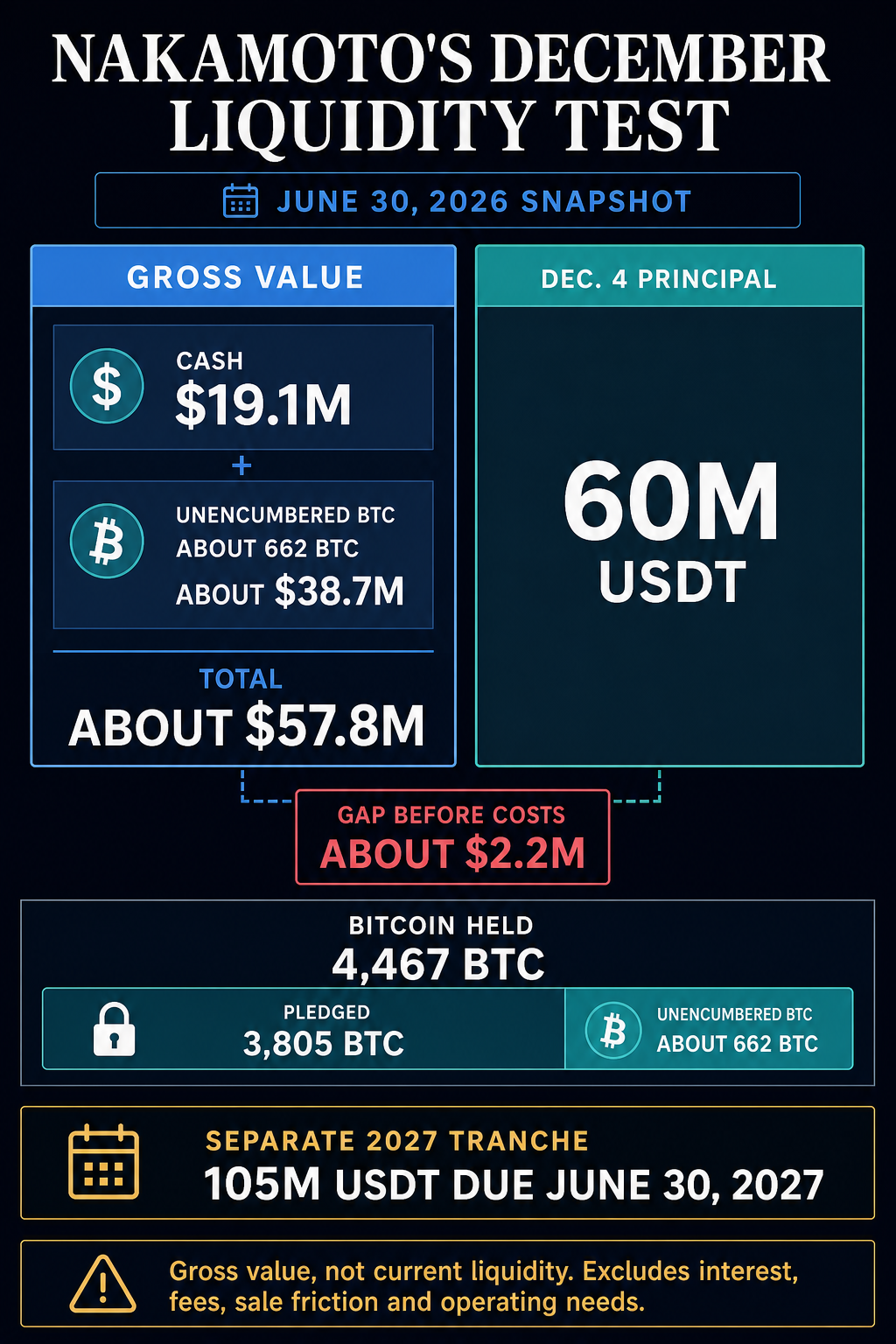
According to the company’s second-quarter regulatory filings, Nakamoto held $19.1 million in cash as of June 30, while a separate 105 million USDT tranche of the loan does not mature until June 2027.
However, assessing the firm’s near-term liquidity is complicated by its treasury structure: the vast majority of its digital asset holdings are already locked up as collateral for the facility.
At the close of the quarter, Nakamoto held 4,467 Bitcoin valued at roughly $261.5 million. Of that stockpile, 3,805 BTC, worth approximately $222.7 million, was pledged to crypto exchange Kraken to secure the loan.
That left the company with just 662 unencumbered BTC, or about $38.7 million in free digital reserves.
Combined, Nakamoto’s cash and unencumbered Bitcoin stood at roughly $57.8 million at quarter-end, narrowly trailing the 60 million USDT obligation due Dec. 4.
While this does not represent an immediate funding shortfall, since the filing notes that pledged tokens can be liquidated at maturity to extinguish the debt, it leaves Nakamoto with a limited unencumbered cushion and a heavy reliance on Bitcoin to support repayment.
The company has already shown a willingness to pare back its core holdings to reduce the facility. In June, Nakamoto offloaded about 600 BTC for 35.6 million USDT and unwound select derivative hedges, generating roughly $48 million in aggregate net proceeds.
The firm directed 45 million USDT toward paying down the facility, cutting the total balance from 210 million USDT to 165 million USDT, while extending 105 million USDT of the principal into mid-2027.
Meanwhile, the primary vulnerability between now and December remains collateral integrity.
Under the credit agreement, the annual loan fee stands at 7.75% as long as Nakamoto maintains at least 2,000 BTC in a designated account, rising to 8% if balances drop below that mark. Crucially, the 2,000 BTC marker serves strictly as a pricing tier rather than a margin trigger.
Nakamoto did not disclose the facility's specific maintenance or liquidation thresholds. A drop below the maintenance line would force the firm to post additional collateral or pay down principal, while breaching the liquidation trigger would constitute an event of default and allow Kraken to liquidate the pledged Bitcoin.
Nevertheless, the Bitcoin treasury company maintained that existing liquidity will satisfy operational cash requirements over the next 12 months, though it acknowledged that a sustained drop in Bitcoin prices could impair its ability to service debt and fund operations.
Headline results offer limited insight into the impending maturity. Nakamoto posted a second-quarter net loss of $133 million, driven primarily by a $105.2 million non-cash goodwill impairment and $48.7 million in mark-to-market losses on its digital asset portfolio.
The firm's adjusted operating income came in at $7.3 million, though that figure was heavily supported by $10.4 million in derivative revenue.
David Bailey, Chairman and Chief Executive Officer of Nakamoto, said:
“While our GAAP results reflect significant non-cash charges from goodwill impairment and the decline in Bitcoin’s price, this quarter we delivered the first positive adjusted operating income since Nakamoto became a Bitcoin operating company.”
The December maturity therefore leaves Nakamoto dependent on a combination of cash, unencumbered assets and pledged Bitcoin that can be sold against the loan.
With most of its BTC still committed as collateral and the facility’s maintenance and liquidation thresholds undisclosed, Bitcoin’s price will remain a key variable before the Dec. 4 payment comes due.