 1 month ago
47
1 month ago
47
Stablecoin supply on the XRP Ledger has climbed to nearly $890 million, up 20.56% over the past 30 days. Ripple's RLUSD explains almost all of that size, and a second dollar token is reshaping who issues XRPL's dollars: Valtorum's USDV, now at $39.3 million.
RLUSD accounts for $844.58 million of that total (94.9%), USDV holds $39.3 million (4.4%), while USDC trails at just $3.7 million.
That climb is happening against a shrinking backdrop, as the global stablecoin market is at $311.39 billion, down 2.31% over the same 30-day period. XRPL is moving in the opposite direction to the broader market, even though the ledger still accounts for only about 0.29% of the global stablecoin supply.
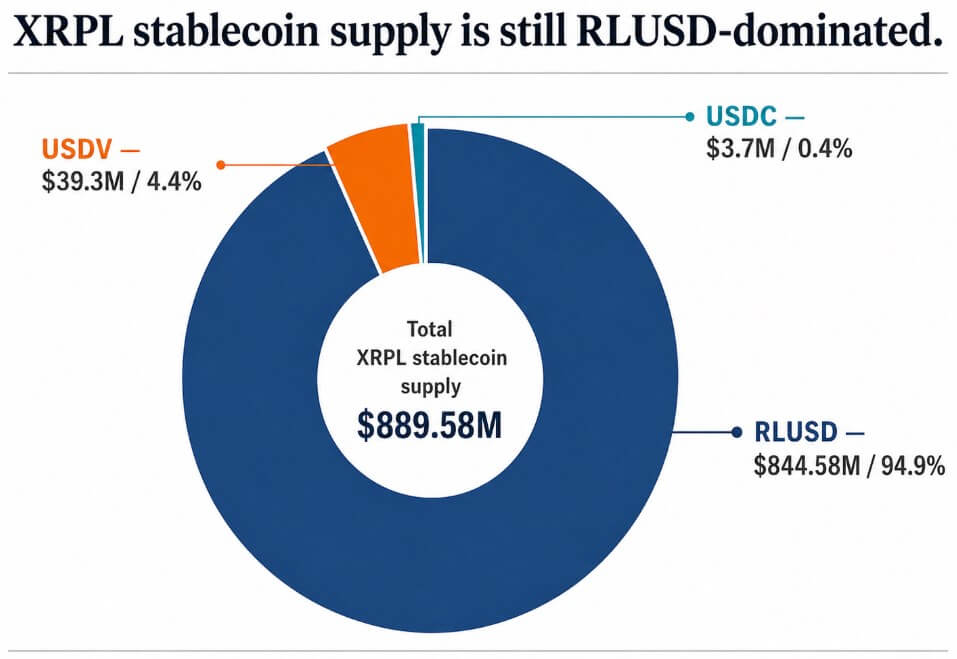 A donut chart shows XRPL's $889.58 million stablecoin supply is dominated by RLUSD at 94.9%, with USDV at 4.4% and USDC at 0.4%.
Where RLUSD is moving
RLUSD still explains the size, as XRPL now holds roughly 51.7% of RLUSD's total supply, up from a smaller share a month earlier. RLUSD's overall market cap fell 9.53% to $1.6 billion over that same period.
RLUSD on XRPL climbed 15.58% over 30 days to $844.6 million, while the stablecoin supply on Ethereum fell 26.61% to $789.8 million over the same stretch.
| XRPL | $844.6M | +15.58% | More RLUSD liquidity is being concentrated on XRPL |
| Ethereum | $789.8M | -26.61% | Supply outside XRPL is shrinking |
| Total RLUSD market cap | ~$1.6B | -9.53% | RLUSD is not expanding everywhere |
| XRPL share of RLUSD | ~51.7% | Rising | XRPL has become the larger RLUSD venue |
Ripple has its own reasons to keep dollars within its payments network. The company's RLUSD page describes the token as natively issued on XRPL and Ethereum, fully backed by segregated cash and cash equivalents.
Ripple built it for payments, remittances, treasury flows, and settlement, so corridor partnerships that route through XRPL, including recent distribution deals, add a plausible reason for more of that liquidity to land there.
The second dollar token
DefiLlama describes USDV as a permissioned dollar token issued by Valtorum on XRPL, in which holder trustlines require issuer authorization before they can transact. The platform lists USDV as fiat-backed and lists its audits field as “No.”
Valtorum's own litepaper describes something broader: a synthetic dollar built for institutions, payment networks, and on-chain markets.
The token is designed for native settlement across XRPL, Stellar, Solana, Sui, and Ethereum. The reserve model it describes can include stablecoins, hard assets, bonds, Treasuries, and crypto collateral, a wider architecture than the fiat-backed label DefiLlama uses.
Valtorum's own reserve dashboard shows feeds still being staged for launch, with reserve coverage marked “attestation pending.”
Only the XRPL registry is live, while the Stellar, Solana, Sui, and Ethereum listings wait their turn. USDV's compliance page states that only wallets and participants approved by Valtorum may participate in the token's network.
XRPL's documentation frames stablecoins as tokens backed by assets held off-ledger, moved on and off via trust lines and pathfinding. A built-in decentralized exchange, automated market makers, and XRP's role as a bridge asset round out the routing.
Whether users are moving dollars yet is a separate question, as XRPL held nearly $890 million in listed stablecoin supply at the time checked.
Against that sat just $3.98 million in 24-hour decentralized exchange volume and $360 in daily chain fees, so dollars have arrived on the ledger well before the payment activity meant to use them.
What comes next
If Valtorum publishes live reserve attestations and USDV's supply climbs from $75 million to $100 million, the mix will no longer look like staging.
| Total XRPL stablecoin supply | Above $1.1B | Confirms growth beyond the current near-$900M level |
| USDV supply | $75M–$100M | Shows the second stablecoin is scaling, not just staged |
| Reserve transparency | Live attestations | Reduces uncertainty around USDV backing |
| Transfer volume | Sustained growth | Shows dollars are moving, not just sitting on-chain |
| Holder growth | Broader wallet distribution | Suggests adoption beyond issuer-controlled liquidity |
| Exchange or corridor support | New integrations | Connects stablecoin supply to real payment routes |
| Downside warning | Below $800M total supply | Suggests the near-$900M print was temporary positioning |
More transfer volume alongside that climb turns it into a genuine multi-issuer settlement rail, and a total XRPL stablecoin supply crossing $1.1 billion would be the clearest marker.
If XRPL's total stablecoin supply slips under $800 million and RLUSD drifts back toward Ethereum, the near-$900 million print starts to look temporary. USDV's supply staying flat would confirm it, an unwind about as fast as the climb that built it.
USDV explains why the stablecoin supply on XRPL now carries more than one signature. What comes next is proof: transfer volume, holder growth, exchange support, and live reserve attestations showing the dollars already there have started to move.