 2 months ago
56
2 months ago
56


For weeks, Bitcoin (BTC) couldn't convincingly break out of the $70,000 zone, which it kept circling as a real problem area.
BTC repeatedly failed to close above that level from early February through early March, making the zone a meaningful area of resistance in a market shedding confidence.
Glassnode's Mar. 11 report described those failures as a sign of weak buy-side demand and overhead supply. However, the ceiling broke, and Bitcoin managed a weekly close above $70,000 on Mar. 14.
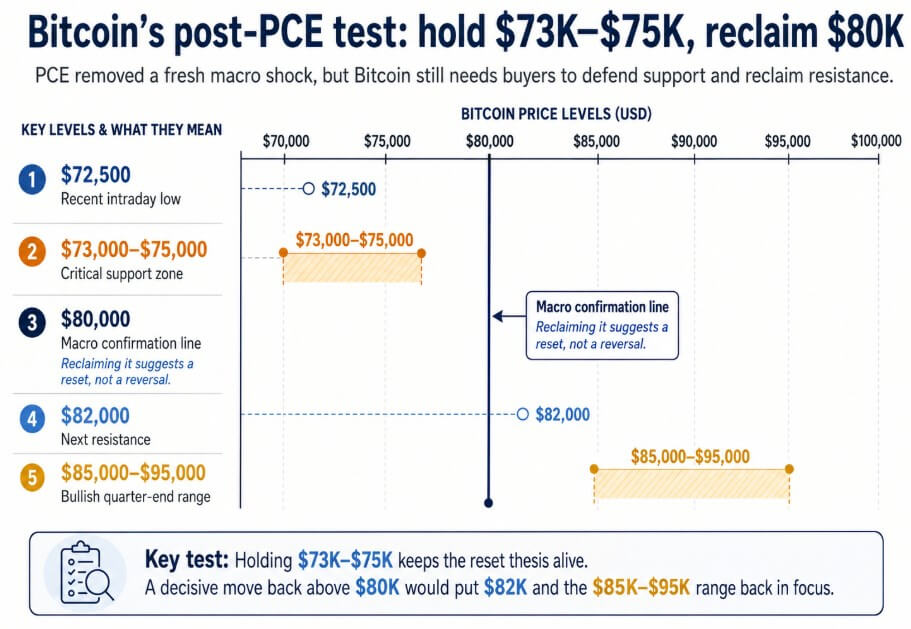
As of press time, Bitcoin has settled to approximately $74,000, with an intraday high near $75,900.
With the weekly close pillar fulfilled, other key metrics drew attention, such as ETF flows and spot demand.
US spot Bitcoin ETFs absorbed around $763 million from Mar. 9 to 13, according to Farside Investors data, and Glassnode reported that buy-side activity was close to offsetting selling pressure.
These metrics show that Bitcoin has moved from “fragile bounce” territory into “possible stabilization” territory. Yet, the next major options cluster sits almost directly overhead at $75,000.
 Bitcoin broke above the $70,000 resistance zone on Mar. 14 and reached approximately $74,200 by Mar. 16, approaching the $75,000 gamma magnet.
The gamma magnet above
Glassnode's Mar. 4 report identified the $75,000 strike as the key gamma magnet, hosting about $2.3 billion of negative gamma across expiries, with roughly $1.8 billion tied to the Mar. 27 expiry.
The Mar. 11 update kept $75,000 as the key upside magnet, this time putting the pocket at roughly $2 billion, and said that if price pushes into that region, dealer hedging could accelerate the move toward $80,000.
Amberdata's Mar. 8 derivatives note described $60,000 and $75,000 as the floor and ceiling of the current gamma box, with dealers holding large short gamma positions at both edges.
The note said that if markets trade beyond that box, negative gamma can make things worse from a dealer rebalancing perspective.
Deribit data recently showed that the BTC-27MAR26-75K-C strike holds roughly 8,000 contracts of open interest, making the zone one of the largest clusters into month-end.
The structure creates a two-way volatility trap.
Negative gamma amplifies moves in both directions. Glassnode explicitly states that a push into $75,000 can accelerate upward toward $80,000, while Amberdata frames moves beyond the $60,000/$75,000 box as amplified in whichever direction the break occurs.
The truth is that $75,000 is where the next move can stop being smooth.
If Bitcoin forces a convincing break above the strike and holds there, short-gamma hedging could help drag the price higher. If it gets rejected and loses momentum at the cluster, the same structure can make the pullback nastier than a normal fade.
| Glassnode | Mar. 4 | $75K | ~$2.3B of negative gamma across expiries; ~$1.8B tied to Mar. 27 | Shows the size of the overhead options cluster |
| Glassnode | Mar. 11 | $75K | Still the key upside magnet; push into the zone could accelerate toward $80K | Confirms the level remained important one week later |
| Amberdata | Mar. 8 | $60K / $75K | Dealers short gamma at both edges; “floor and ceiling of the box” | Frames the current range as mechanically unstable at the boundaries |
| Deribit / market data | Recent | $75K strike | ~8,000 contracts of open interest at BTC-27MAR26-75K-C | Shows the crowding into month-end |
Why this setup exists
The negative gamma concentration at $75,000 reflects a market that has been range-bound for months.
Dealers sold options to collect premium while Bitcoin chopped between $60,000 and $75,000, and those positions have accumulated at the boundaries.
The Mar. 27 expiry deadline sharpens the setup because about $1.8 billion of the $75,000 negative gamma pocket expires then, potentially leaving the current gamma map to persist into April. That gives the current threshold real urgency.
The backdrop also makes a crowded strike more dangerous. Last week, global equity funds saw $7 billion of outflows, while Brent traded above $100 and the VIX hit 28.15, its highest since November.
Barclays joined Goldman Sachs in pushing back its expected first Fed cut to September, with only one 25-basis-point cut now expected this year amid elevated Middle East-driven inflation risks.
In that environment, a crowded Bitcoin strike can become a volatility transmission point for macro headlines, turning a crypto-native level into a regime-break indicator.
The stabilization versus stress debate
Bitcoin's move back above $70,000 makes the case that it's strong enough to force dealers to chase price through the biggest overhead options cluster on the board.
Glassnode's Mar. 11 note described near-term dealer gamma as neutral, which sounds calming. Neutral dealer gamma still allows violent price action when the asset is sitting just under a $2 billion negative gamma pocket.
Amberdata's base case assumes consolidation, with the market needing to trade “within the box” as realized volatility runs at 77% on a 30-day daily candle basis versus 58% on a monthly candle basis.
That implies a calmer regime, but one with explosive edges.
The Mar. 27 expiry becomes a deadline for the current range to either break or persist. If Bitcoin holds above $75,000 before then, the hedging flows could help accelerate the move. If it stalls and pulls back, the same structure can amplify the rejection.
 The $75,000 strike holds roughly $2 billion in negative gamma expiring Mar. 27, creating two potential paths: breakout toward $80,000 or rejection toward $60,000.
What decides the outcome
The cleanest bull case assumes a convincing move through $75,000, with Bitcoin holding above the strike long enough to force dealer rehedging.
Glassnode's setup implies that hedging could accelerate the price toward roughly $80,000 in that scenario.
The bear case assumes a hard rejection at $75,000, with Bitcoin slipping back through the low-$70,000s.
In that case, the same short-gamma structure can make the pullback uglier, potentially reopening a move toward the mid-$60,000s and the $60,000 edge of Amberdata's box.
The macro wildcard sits above the chart. A fresh escalation in the Middle East or a hawkish Fed surprise could shove Bitcoin violently through one side of the box.
In that scenario, the options structure amplifies the move, but macro supplies the spark.
The negative gamma test is close enough to feel urgent, and the structure is sharp enough to make the next move violent.
Currently, Bitcoin is consolidating around a resistance-turned-support at $73,750-$74250 after being rejected at $76,000, so neither bull, bear, nor the wildcard scenario has yet been confirmed.