 3 months ago
78
3 months ago
78


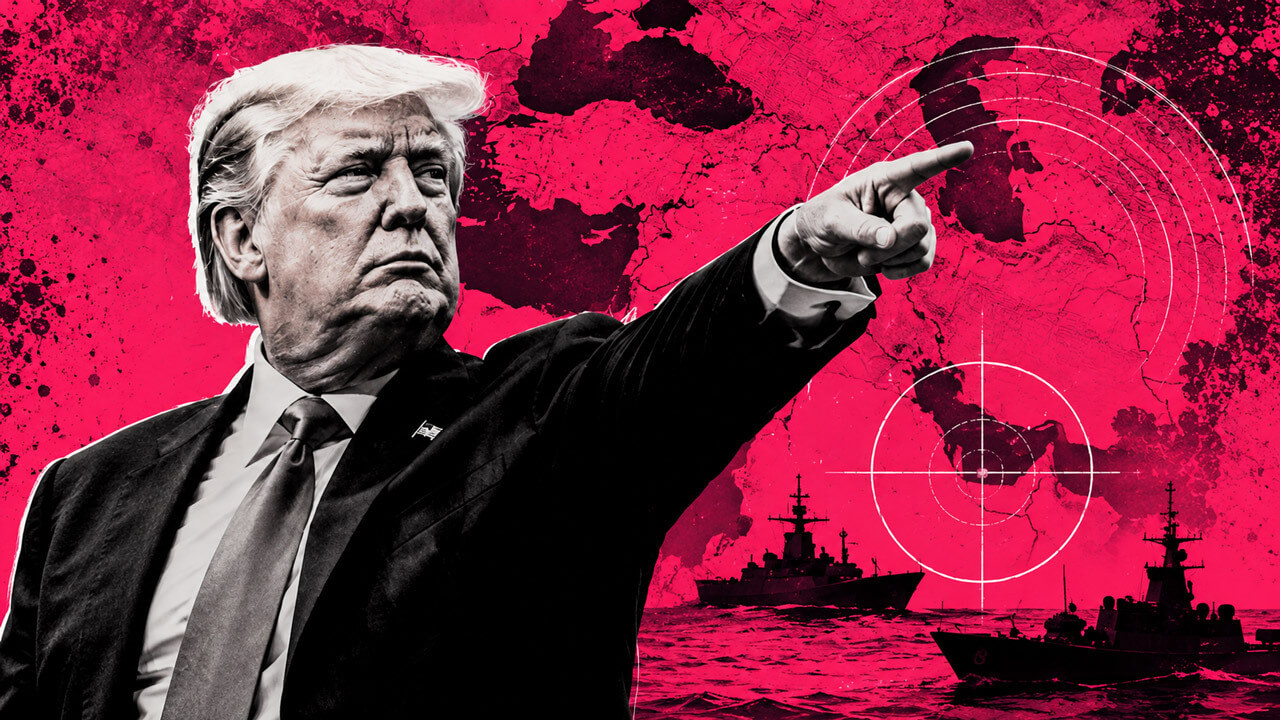
Marco Rubio sat down with G7 foreign ministers and told them privately that the war with Iran could continue another two to four weeks, handing Washington's closest allies and the market a countdown.
Reports noted that Rubio publicly said the operation should conclude in “weeks, not months,” and the gap between those two framings captures the window long enough to sustain macro strain where Bitcoin now trades.
Bitcoin reached an intraday low of $65,571.07 on Mar. 27, down roughly 4.4% on the day. Meanwhile, Brent crude was at $111.52, up 53% since the war began on Feb. 27.
The Nasdaq had entered correction territory, the 10-year Treasury yield stood at 4.44%, and Fed futures reflected essentially zero probability of a rate cut this year. That combination explains Bitcoin's session losses with precision.
| Bitcoin (BTC) | $65,571.07 | Down ~4.4% on Mar. 27 |
| Brent crude | $111.52 | Up 53% since Feb. 27 |
| Nasdaq Composite | Correction territory | Risk assets under pressure |
| U.S. 10-year Treasury yield | 4.44% | Higher yields tightening financial conditions |
| Fed futures | ~0% probability of a rate cut this year | Markets pricing a rate-cut freeze |
The transmission chain
Oil above $100 pushes freight costs into every supply chain simultaneously.
EIA data shows tanker rates for VLCCs from the Middle East to Asia hit their highest level since at least November 2005 in March. Stickier inflation expectations follow, as University of Michigan consumer sentiment fell to 53.3, and one-year inflation expectations jumped from 3.4% to 3.8%.
Fed Governor Lisa Cook said the war in Iran has shifted the balance of risks toward inflation, cementing a rate-cut freeze that is the direct channel into Bitcoin.
Bitcoin has come to trade like a high-beta liquidity instrument. The IMF has documented that its correlation with equities is higher than its correlations with gold, bonds, or major currencies.
A 2024 study in Finance Research Letters found that Bitcoin returns and volatility tend to respond to political uncertainty shocks, particularly during periods of financial stress. Bitcoin trades lower now because a longer war keeps the oil shock alive, which keeps liquidity tight.
Rubio's two-to-four-week private estimate turns a sequence of daily military headlines into a timeboxed repricing: traders now price the duration of the shock, treating each military headline as a data point in a longer repricing cycle.
Duration is the key
Traders are now pricing the war's duration, treating each military or diplomatic headline as a data point in a longer repricing cycle.
ICE recorded its highest-ever crude trading and open interest through March, indicating persistent repricing.
When President Donald Trump delayed strikes on Iranian energy infrastructure and hopes of de-escalation rose, global equity funds took in $37.77 billion in the week through Mar. 25. When Iran denied talks and hopes of a ceasefire faded, equities fell again.
The market toggles based on how the duration of the energy shock looks, and Rubio's private timeline pushed the dial toward durable.
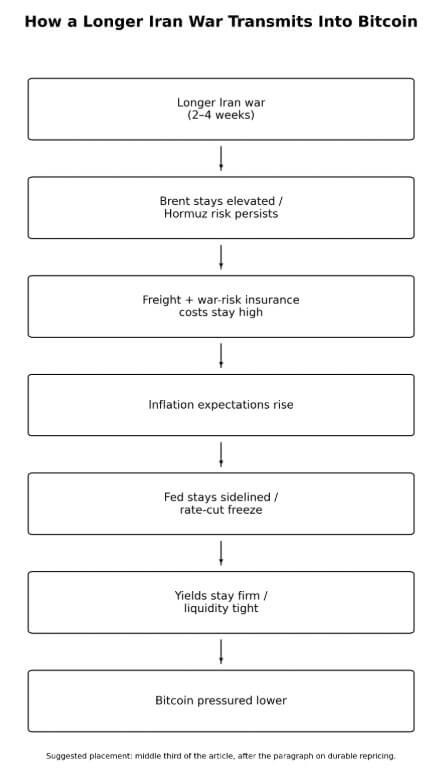 A flowchart illustrating the seven-step transmission chain from a prolonged Iran war through rising oil costs, inflation, and tighter liquidity to lower Bitcoin prices.
A Reuters analyst poll put Brent at $100 to $190 under sustained disruption, with an average of $134.62. At the same time, EIA's March outlook projects Brent above $95 for the next two months. Bitcoin's near-term range is currently within this gap.
Flows through the Strait of Hormuz averaged roughly 20 million barrels per day in 2024, approximately 20% of global petroleum liquids consumption, with about 84% of that crude going to Asia.
The first-order macro hit lands in the region most central to industrial demand, emerging-market foreign exchange, and the technology supply chain.
Foreign investors pulled roughly $25.28 billion from Taiwan, $13.5 billion from South Korea, and $10.17 billion from India this month. Bitcoin sits inside the same global growth and technology complex that foreign outflows are actively repricing, and those moves reflect the same liquidity logic driving crypto lower.
EIA notes that only about 2.6 million barrels per day of Saudi and UAE pipeline bypass capacity is readily available.
Physical Hormuz navigation controls the macro calculus more than any diplomatic statement, which is why a ceasefire that leaves shipping impaired delivers limited relief.
War risk insurance alone keeps freight costs elevated enough to extend the inflation pass-through even if military operations pause.
The countdown
For the potential scenarios in the coming weeks, the best option involves diplomacy to close the gap within roughly seven to ten days.
Shipping normalization begins, Brent retreats toward $95-$110, and the “no cuts in 2026” narrative softens as inflation expectations ease. Goldman Sachs has argued that a clear end to military action would quickly erode the oil risk premium.
On that path, Bitcoin's exposure to the macro squeeze reverses rapidly. The relief puts Bitcoin in the $69,000-$75,000 range, supported by the EIA's easing post-disruption base case and by the speed at which equity funds re-entered when de-escalation hopes climbed in late March.
The same liquidity sensitivity that drove the selloff drives the recovery.
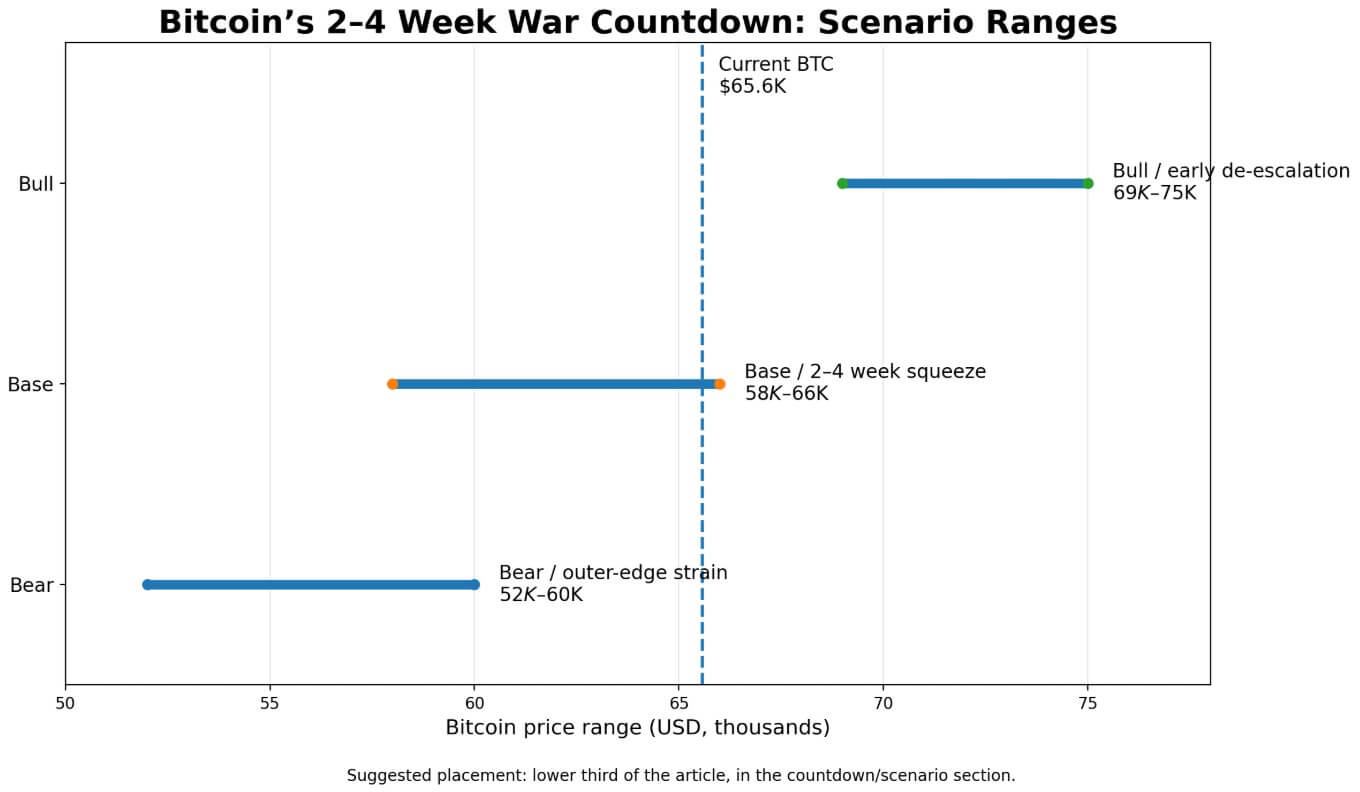 A horizontal range chart mapping three Bitcoin price scenarios, bull ($69K–$75K), base ($58K–$66K), and bear ($52K–$60K), against the current price of $65.6K during the Iran war's projected 2-4 week countdown.
In the worst-case scenario, the war runs to the outer edge of Rubio's four-week window. Hormuz friction persists, war-risk insurance stays elevated, and no convincing ceasefire emerges.
Brent holds in the $110–$135 range, consistent with Goldman's March-April expectation and the Reuters average under sustained disruption. Inflation stays uncomfortable, the Fed stays sidelined, and Bitcoin trades in a $58,000-$66,000 range as risk assets stay capped by the same liquidity ceiling in place since Feb. 27.
The academic literature reinforces this framing over any reflexive safe-haven narrative.
A 2025 quantile analysis paper found that gold, the US dollar, and oil hedge geopolitical risk more consistently than cryptocurrencies across varying risk levels. Another 2025 study found that Bitcoin's defensive properties activate under geopolitically driven crash conditions, a threshold the current oil-and-yield squeeze has not yet reached.
In the bear case, the squeeze persists long enough to validate that conditional framing: Bitcoin's haven behavior is regime-dependent, and a sustained oil-inflation-yield environment is the least favorable regime for those properties to activate.
Two to four more weeks of war means at least one more inflation print, one more Fed meeting, and one more month of elevated freight and energy costs before the macro backdrop begins to clear.
For Bitcoin, that window represents the duration during which oil stays high and rate cuts stay off the table, the two conditions that drive the liquidity ceiling on risk assets.
The bull case closes that window early and reverses the compression, and the bear case holds it open long enough to validate the liquidity-asset framing that has governed Bitcoin's price action since February.
Markets are already pricing the countdown without considering the optimistic version.