 2 months ago
113
2 months ago
113


Bitcoin continued its upward momentum above $71,000 on Tuesday as investors continued to weigh the market impact of President Donald Trump’s decision to pause planned US attacks on Iranian power and energy infrastructure for five days.
Data from CryptoSlate showed that the top cryptocurrency was trading at around $71,185 as of press time, rising 4% during the session.
The price broke through a level that traders have been watching as a test of whether institutional demand can continue to absorb pressure from war risk, rising energy prices, and a Federal Reserve that has signaled a slower path toward easier monetary policy.
The latest turn in the conflict first hit crude, then spread across currencies, stocks, and digital assets.
Brent crude fell more than 13% after Trump announced the pause, briefly dropping toward $96 a barrel before rebounding above $102 as traders reassessed the prospect of wider disruption and Iran pushed back on the idea of direct talks.
However, Bitcoin’s response drew attention because the digital asset avoided a deeper break lower during a week in which oil, war, and rate expectations were all moving at once.
The price action reinforced a market view that BTC has become more closely tied to broader liquidity conditions and institutional positioning than it was during earlier cycles dominated by retail flows.
Oil remains the key market channel
The central link between the conflict and global markets runs through the Strait of Hormuz.
The International Energy Agency says about 25% of global seaborne oil trade and nearly 20% of global liquefied natural gas trade moved through Hormuz in 2025. The US Energy Information Administration has also identified the route as one of the world’s most important energy chokepoints, with nearly one-fifth of global oil supply moving through it.
That leaves traders treating any shift in the US-Iran conflict primarily as an oil market event. A sustained rise in crude can lift inflation expectations, delay central-bank easing, and tighten broader financial conditions.
For Bitcoin, that sequence has become increasingly important as exchange-traded products, large allocators, and macro funds take a larger share of trading activity.
The Fed reinforced that backdrop on March 18, when it left its benchmark rate unchanged at 3.5% to 3.75%. Policymakers projected 2026 headline and core personal consumption expenditures inflation at 2.7%, and the median estimate for the year-end 2026 federal funds rate remained at 3.4%.
Those projections signaled that officials still expect inflation to cool gradually, with little room for a rapid easing cycle if energy prices continue to pressure the outlook.
For Bitcoin, that means geopolitical stress is only one part of the equation. A rally can extend more easily when crude retreats, inflation expectations ease, and rate-cut expectations strengthen. When oil remains elevated, crypto has to contend with a tighter macro backdrop even if military headlines do not worsen.
That dynamic helps explain the market’s response over the past several sessions. The pause in planned strikes on Iranian energy infrastructure prompted relief across global markets, yet the bounce in crude above $100 a barrel showed how quickly sentiment can reverse when traders focus again on Hormuz and the risk of disruption to supply flows.
Fund flows point to demand, with the Fed still steering short-term swings
Investment-product data suggest capital has continued to move into Bitcoin even as the macro backdrop has become less supportive.
Over the past two weeks, asset management firm CoinShares reported inflows of over $1.2 billion into digital-asset investment products, with Bitcoin accounting for around $900 million of that total.
The firm also said assets under management in digital-asset products had risen by nearly 10% to over $140 billion since the Iran crisis began.
The details of those reports offered a clearer read on what has been driving price swings. Last week, CoinShares said digital-asset products took in $635 million during the first two days of the week, then swung to $405 million of outflows after the March 18 Fed decision.
That sequence suggests Bitcoin has held up through geopolitical stress while remaining highly sensitive to the path of monetary policy. Investors continued to add exposure, yet they also responded quickly when the Fed signaled that rates may stay restrictive for longer.
The pattern aligns with a broader market view that Bitcoin entered the latest period of stress from a cleaner starting point than earlier in the quarter.
CoinShares argued in its Iran-conflict analysis that whale distribution had already been heavy, valuations had already compressed, and leverage had already moved closer to long-run norms before the latest military escalation.
With much of that reset already in place, the next shock encountered a market carrying less excess positioning.
On-chain and derivatives data define the next range
Market-structure data show improvement, though the breakout case still depends on whether Bitcoin can hold above recent recovery levels.
Glassnode said Bitcoin has moved through a dense supply zone between $59,000 and $72,000 and entered a thinner trading band between $72,000 and $82,000, where historical turnover is lighter.
The firm said about 60% of the circulating supply was in profit, below the 75% level that has, in past cycles, aligned with a more established early-bull phase.
That leaves Bitcoin in a zone where the market has repaired some of the earlier panic damage, though it has not yet shown that profit-taking can be absorbed consistently at higher prices. A stable hold above $70,000 would strengthen the case for challenging the upper end of that thinner range. A
However, a drop back into the old $59,000 to $72,000 cluster would place the market back in heavier traffic, where supply has previously capped advances.
Options positioning points to the same conclusion.
Coinbase-owned Deribit said downside hedging has been concentrated between $61,000 and $64,000, while open interest has also built up at higher strikes, including $75,000 and $125,000. In a recent note, the exchange said a break above $75,000 could trigger dealer hedging flows that add momentum to the upside.
That leaves traders with a relatively clear map. The low-$60,000 area is where protection has been concentrated.
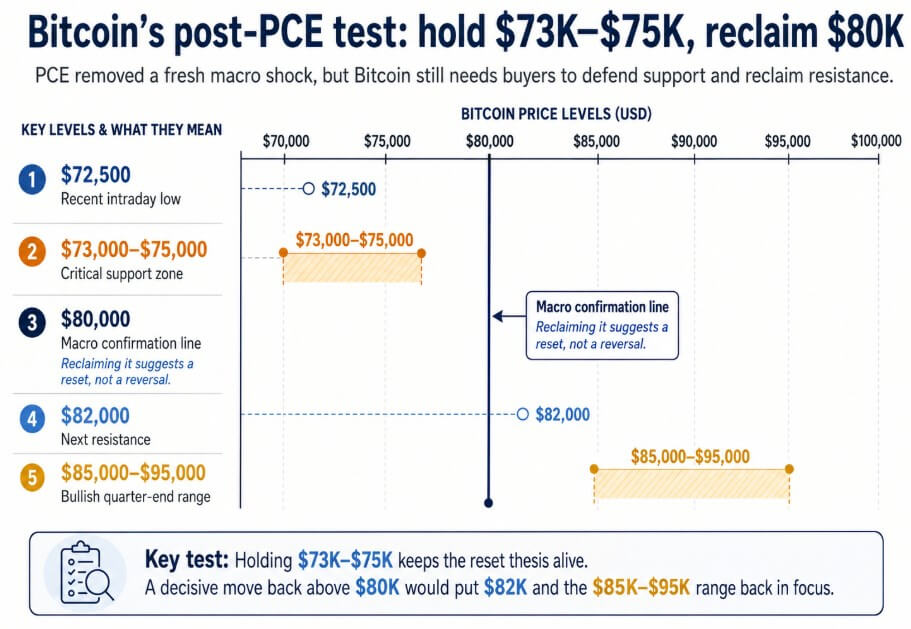
The $75,000 level is where upside positioning could begin to influence market mechanics more forcefully. Between those points, Bitcoin remains in a range shaped by both macro pressure and steady product demand.
Citi added another reference point earlier this month when it published a 12-month base target of $112,000 for Bitcoin, alongside a bull-case target of $165,000 and a recession-case target of $58,000.
Those figures provide a broader context for the market’s current position. A recovery through $75,000 and then $82,000 would place the price path closer to the higher end of that outlook. Still, renewed pressure from oil and policy expectations would pull attention back toward the lower scenarios.
Cross-asset flows show a selective repositioning
Broader asset-allocation data suggest investors are responding to the conflict with a mix of caution and selective risk-taking rather than a simple flight into traditional havens.
Reuters, citing BofA Global Research and EPFR data, reported that investors in a recent week put $62.2 billion into stocks, $10.2 billion into bonds, $1 billion into crypto, and $23.5 billion into cash, while pulling $4.5 billion from gold.
That mix points to selective dip-buying alongside a sizable move into cash. It also shows that Bitcoin has remained part of the investable risk complex even during a period of military escalation and sharp energy moves. The token has drawn continued inflows, though within a market still focused on oil, inflation, and the Fed.
For Bitcoin, the next phase is likely to depend heavily on the direction of crude.
A retreat in Brent, combined with continued inflows into exchange-traded and other investment products, would improve the case for a move through $75,000 and into the $72,000 to $82,000 air gap identified by Glassnode.
However, a sustained move higher in oil would keep inflation pressure alive and preserve a tighter policy backdrop, conditions that could shift attention back toward $64,000 and then $58,000.