 3 months ago
68
3 months ago
68
USDT stablecoin issuer Tether has stepped in to anchor a massive recovery plan for Drift Protocol, the Solana-based decentralized exchange (DEX) that was crippled by a $286 million exploit earlier this month.
However, the rescue package includes a potent commercial string that could challenge Circle's dominance of USDC on the Solana blockchain.
According to the recovery plan, Drift must abandon its long-standing reliance on Circle Internet Financial's USDC and pivot its entire ecosystem to Tether's USDT.
The deal marks a calculated offensive by Tether to capture market share on Solana, a blockchain that has rapidly emerged as the primary battlefield for retail payments and high-frequency decentralized finance (DeFi).
While USDT remains the global king of liquidity with a market capitalization of $185 billion, it has historically trailed Circle on the Solana network. By bailing out one of the ecosystem's most prominent protocols, Tether is effectively buying a seat at the head of the table.
The price of Drift's lifeline
The recovery framework, announced on April 16, involves a $127.5 million injection from Tether.
Additional unnamed partners are expected to contribute a further $20 million to help fill the hole left by the April 1 heist.
Investigators have since attributed the attack to North Korean cybercriminals who allegedly spent months infiltrating the Drift team through “social engineering,” posing as legitimate traders at industry conferences to gain the trust of developers.
To make users whole, Drift will issue a specialized “recovery token.” Unlike the protocol's DRIFT governance asset, these tokens represent a direct claim on a $295 million reimbursement pool.
The tokens will be transferable, allowing victims to exit their positions and access liquidity immediately rather than waiting for the multi-year process of law enforcement asset recovery.
However, the most significant structural change is the “USDT-first” mandate.
Drift's entire settlement layer, the engine that clears and settles trades, will migrate from USDC to USDT. The transition will bring more than 128,000 active users and 35 ecosystem partners under Tether's umbrella.
Cindy Leow, the co-founder of Drift, said:
“The collaboration is structured around a clear, revenue-driven recovery mechanism designed to prioritize users from day one through a revenue-linked credit facility, an ecosystem grant, and loans to market-makers.”
Leow further explained that “a substantial portion of exchange revenue, together with committed support capital, is intended to fund a dedicated user recovery pool.”
How Tether's USDT is gaining a foothold over Circle's USDC
Some analysts are framing Drift's pivot to USDT as an implicit but pointed critique of Circle's handling of the exploit.
In the immediate aftermath of the April 1 hack, several prominent blockchain investigators, including ZachXBT, publicly slammed Circle for failing to freeze the stolen funds quickly enough.
However, Circle defended its position, saying it freezes USDC only when legally compelled by the appropriate authorities and argued that “the power to freeze is not the power to police.”
The USDC issuer also framed unilateral intervention as inconsistent with due process and property-rights protections, while also saying it stood ready to support accountability efforts within the limits of the law.
That response may have been legally and operationally consistent with Circle's regulatory positioning, but it also exposed a commercial vulnerability. In moments of acute stress, crypto users and protocols often reward the party seen as moving fastest to protect funds, not the one making the cleanest legal argument.
Circle's posture also contrasts with that of Tether, which has often leaned into its role as an active “policeman” of its own rails, frequently freezing assets at the request of law enforcement or in response to major exploits.
“Tether moves faster in cases like these,” noted DeFi analyst Ignas. “I always preferred USDC because of its supposedly ‘safer' status. Yet it was USDC that experienced the largest depeg during the banking crisis, while Circle failed to freeze these hacked funds. Tether is positioning itself as the safer option for the retail user who wants protection.”
This sentiment was also echoed by Lorenzo Romagnoli, co-founder of the USDT0 bridge protocol, which reportedly froze its Solana bridge within 29 minutes of the Drift exploit. He stated:
“People gravitate toward solutions that protect them in difficult moments.”
The battle for Solana's payment rails
Tether's aggressive move comes as Solana's importance to the global financial system reaches a tipping point.
In February 2026, Grayscale reported that stablecoin transaction volume on Solana hit a record $650 billion, driven by its low fees and high throughput.
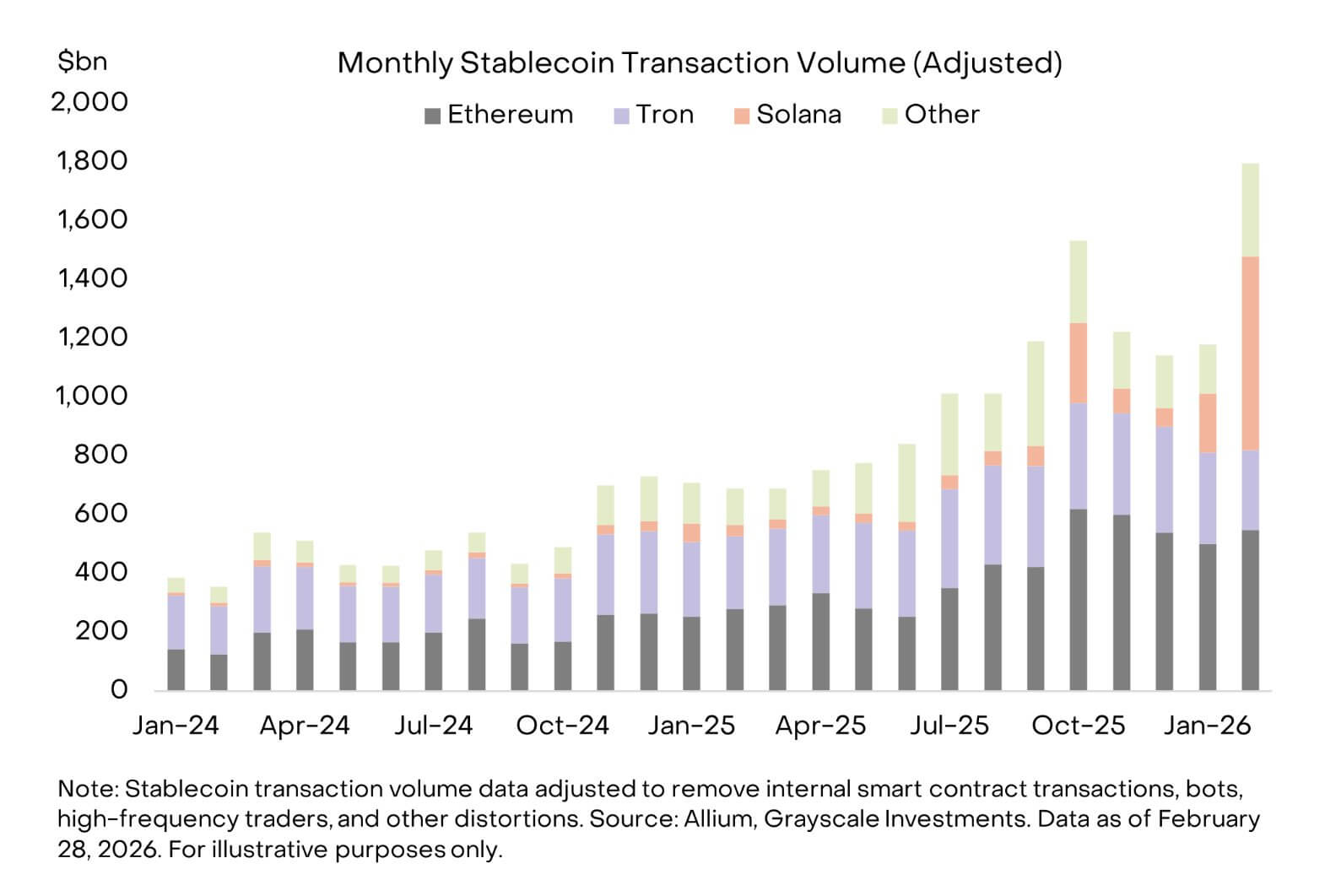 Solana Stablecoin Volume (Source: Grayscale)
For years, Circle's USDC has been the “Goldilocks” asset for Solana users, currently commanding over $8.1 billion in supply, accounting for over 52% of the network's $15.5 billion total stablecoin supply. Notably, USDC's supply represents nearly triple that of Tether's $3 billion presence there.
This dominance has been bolstered by partnerships with several traditional finance giants, including Visa, PayPal, Stripe, Western Union, and Fiserv, running production workflows on the network.
However, the tide may be turning.
Data from Blockworks Research indicates that USDC's market share on Solana has slipped from a peak of 80% to approximately 55% as of early 2026. Over that same period, USDT's share has climbed to 21%.
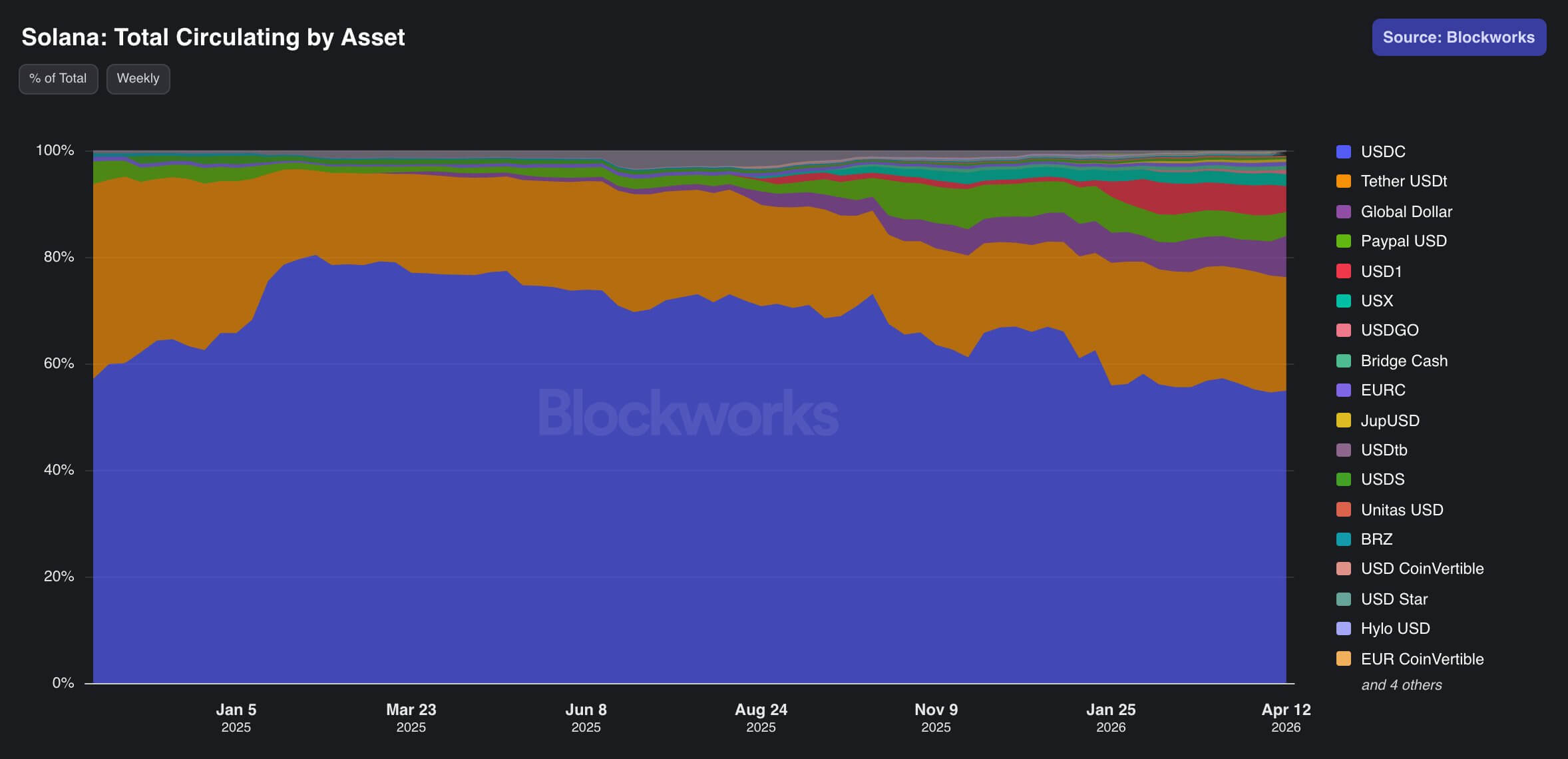 Solana Stablecoin Supply (Source: Blockworks)
Market observers argue that Tether's move to capture Drift could be an attempt to accelerate this decline and capture the lucrative fees associated with high-velocity retail payments.
Truda, an independent crypto analyst, opined:
“Think deeper. Spend $100 million to save Drift, and suddenly every other protocol on Solana starts looking at USDT as having an ‘unspoken bailout mechanism.' It’s a bid for world domination.”
A new era of transparency?
Meanwhile, Tether's expansion onto Solana's payment rails coincides with an unprecedented push for institutional legitimacy.
Long considered a pariah in US regulatory circles, the company is now attempting to shed its reputation for opacity.
Tether has reportedly engaged KPMG to conduct a comprehensive financial audit of its $185 billion in reserves, moving beyond the “attestations” it has used for years.
This shift is partially driven by the GENIUS Act, a landmark US piece of legislation that has required stablecoin issuers to meet stricter transparency standards. As part of this evolution, Tether recently launched “USAT,” a specialized token compliant with the new American framework.
The efforts come as the company is also reportedly eyeing a massive $20 billion fundraising round that would value the El Salvador-based firm at $500 billion.
However, the Financial Times reports that some investors remain hesitant, citing the historical baggage of Tether's $18.5 million settlement with the New York Attorney General in 2021 and ongoing scrutiny regarding the use of USDT in illicit finance.
Nonetheless, these efforts would allow it to more directly compete with the regulatory posture that Circle has long used as a core advantage for its USDC stablecoin.
So, as Drift prepares to relaunch following audits by security firms OtterSec and Asymmetric, the crypto industry is watching closely.
The “Drift Bailout” is more than just a recovery plan; it is a signal that Tether is no longer content being the reserve currency of offshore exchanges. It wants to be the settlement layer for the future of retail payments, and it is willing to pay nine figures to secure that spot.