 1 month ago
46
1 month ago
46
Bitcoin climbed back above $70,000 on Wednesday after news that the United States and Iran had agreed to a Pakistan-brokered two-week ceasefire tied to reopening the Strait of Hormuz.
According to CryptoSlate's data, the top crypto rose 5% to a peak of $72,734 before retracing to $71,477 as of press time.
Data from CryptoQuant showed that within two hours of the news, the top crypto recorded about $3 bilion in taker buy volume on Binance's derivatives markets, indicating how quickly investors repositioned, while hoping the situation continues to evolve positively.
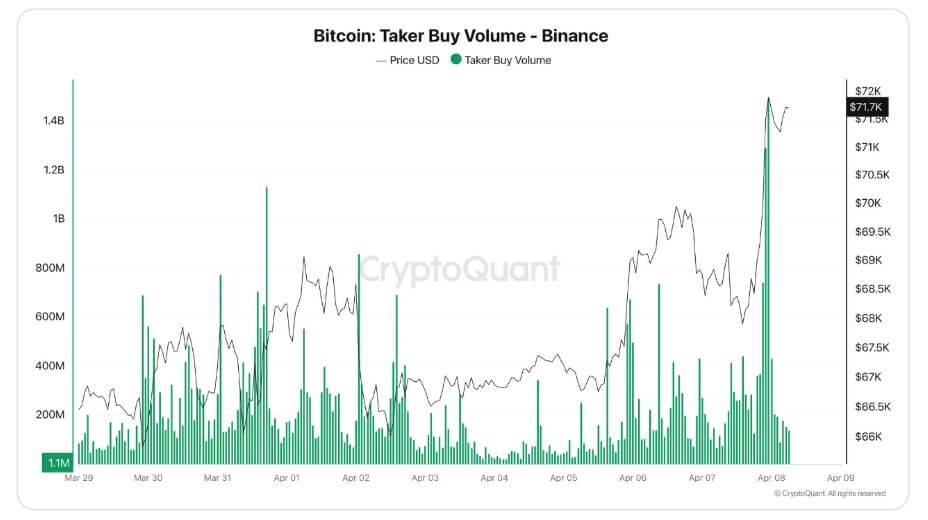 Bitcoin Taker Buy Volume (Source: CryptoQuant)
Meanwhile, the truce announcement also helped trigger a broad relief move across global markets. Brent crude fell 13.8% to $94.25, and US crude dropped 15.4% to $95.52, while Germany’s DAX rose 4.7%, Japan’s Nikkei 225 gained 5.4%, and South Korea’s Kospi jumped 6.9%.
However, Bitcoin’s recent return above $70,000 is not the first time that the flagship digital asset has climbed above that threshold following new peace signs in the US-Iran war.
Maksym Sakharov, co-founder and group CEO of WeFi, told CryptoSlate:
“Whenever there’s tension — geopolitics, macro, and even institutional or micro — the weak investors and traders are always shaken out. The fear is now partly gone with the ceasefire news, but holding onto the $70,000 mark would take more than just a ceasefire.”
As a result, the question arises of whether the current rally can be sustained or whether BTC will experience another sell-off.
Oil is still the first link in the chain
The Strait of Hormuz remains central to that calculation of whether BTC can sustain its current upward move.
About 20% of global oil exports move through the waterway, making any disruption there a direct threat to energy prices, freight costs, and inflation expectations.
During the recent escalation, reports revealed that roughly 130 million barrels of crude and 46 million barrels of refined fuel were stranded on around 200 tankers in the Gulf as traffic was disrupted.
Due to this, Brent had surged 55% since Feb. 28, and some physical oil markets were pricing crude near $150 a barrel before the ceasefire was announced.
That helps explain why the market reaction was so sharp once the truce was reported. Lower oil does not simply reduce one source of headline risk. It also eases one of the most immediate threats to the global macro outlook: a prolonged energy shock could revive inflation just as central banks were looking for room to loosen policy.
Notably, Chicago Fed President Austan Goolsbee had warned that the war was creating a stagflation shock, while Dallas Fed research suggested that a longer Hormuz disruption could push US headline inflation above 4% by year-end.
However, with the new peace deal, Josh Gilbert, market analyst at eToro, told CryptoSlate that the decline in oil prices signaled that the markets had begun to price in a reopening of Hormuz.
According to him, this lower oil price is broadly supportive for global markets because it reduces pressure on consumers, moderates inflation expectations, and removes one of the headwinds that had weighed on equities in recent weeks.
For Bitcoin, that shift is crucial. The flagship asset did not break higher as oil surged and war fears intensified. However, it moved when oil dropped, equities rallied, and investors started to price in a less acute inflation shock.
Price is back above $70,000, but the support is uneven
Bitcoin’s recent move through the $70,000 threshold was notable, but the trading pattern showed that conviction remains limited.
Earlier this month, Glassnode had explained that Bitcoin was trapped in a $60,000 to $70,000 range, with about 8.4 million BTC still underwater and a heavy supply cluster sitting above the market between $80,000 and $126,000.
That creates two constraints at once. First, it means many holders are still looking for higher prices to reduce losses or exit. Second, it means any move beyond $70,000 still faces meaningful overhead supply before it can develop into something more sustained.
Apart from that, institutional interest in the top crypto remains uneven as the digital asset continues to record significant inflows and outflows.
US spot exchange-traded fund data compiled by SoSoValue has shown sharp swings over the past weeks, with the nine funds recording an $173.7 million outflow on April 1, followed by a $471.4 million inflow on April 6, then renewed outflows on April 7.
These numbers show that top crypto is still not enjoying strong institutional support. This is because a market that can remain above $70,000 for weeks usually shows a steadier pattern of spot demand than one that alternates between large inflows and large outflows over a few sessions.
Moreover, derivatives data also suggest traders are not treating the latest move as a confirmed breakout.
Greeks.live said Bitcoin’s surge toward $72,000 improved sentiment mainly by reducing fears of a black swan-style crash rather than creating expectations for a sustained run higher.
The firm noted that BTC's implied volatility on major-expiry options continued to fall, while near-expiry implied volatility also declined.
It continued that while the negative skew eased as the price rallied, the broader message from options positioning was that traders had become less fearful of an immediate collapse, not convinced of a lasting upside regime.
What next for Bitcoin?
For Bitcoin to remain above $70,000 over the next two to six weeks, the ceasefire has to do more than survive the first headline cycle. Tanker traffic through Hormuz would need to normalize.
Oil would need to stay below the recent panic zone near or above $109. Inflation fears would need to ease rather than reaccelerate. ETF flows would need to remain positive on balance, rather than flip between one-day surges and one-day withdrawals.
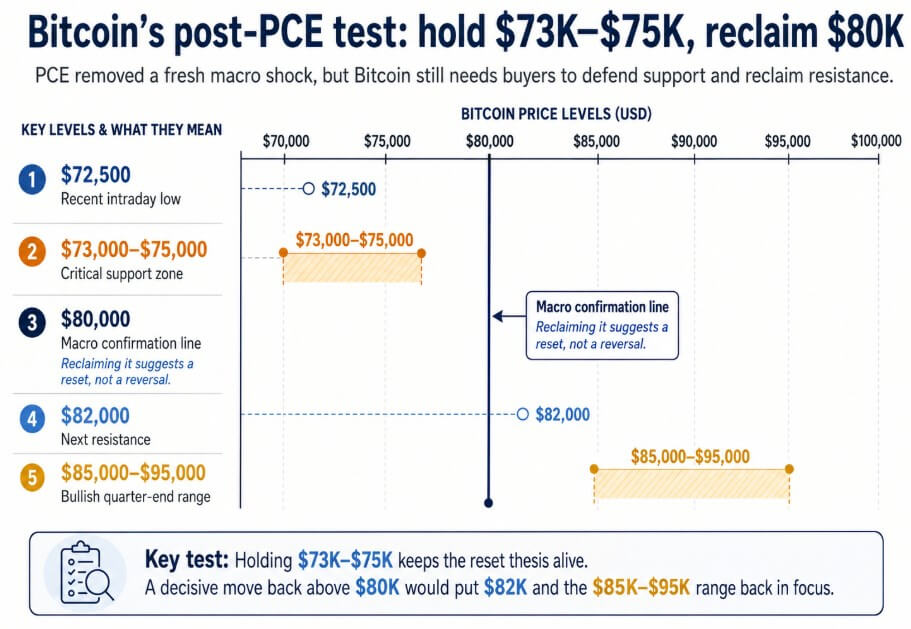
If that happens, Bitcoin has a credible path to trade in a $70,000 to $78,000 range, with room toward the low $80,000s if spot demand strengthens and derivatives positioning stops leaning defensively.
Andre Dragosch, Bitwise’s head of research in Europe, said a sustainable break above $80,000 would be more likely to shift the market from a bearish to a bullish psychology because several key valuation and cost-basis markers converge around that level.
However, if the truce breaks down, shipping disruptions return, and crude rebounds, the token could slip back into the $62,000 to $69,000 band that defined the market before this week’s move.