 2 hours ago
1
2 hours ago
1
Japan’s latest 20-year government bond auction signaled a higher price for long-term borrowing, not a collapse in demand.
The average accepted yield rose to 3.856% on Tuesday, 15.8 basis points above the 3.698% average on Aug. 20. Competitive bid coverage improved slightly to about 4.01 times from 3.98 times, while the gap between the highest accepted and average yields narrowed to 1.3 basis points from 1.5.
Those measures are consistent with orderly absorption at a higher yield. They do not support describing the auction as a failed sale.
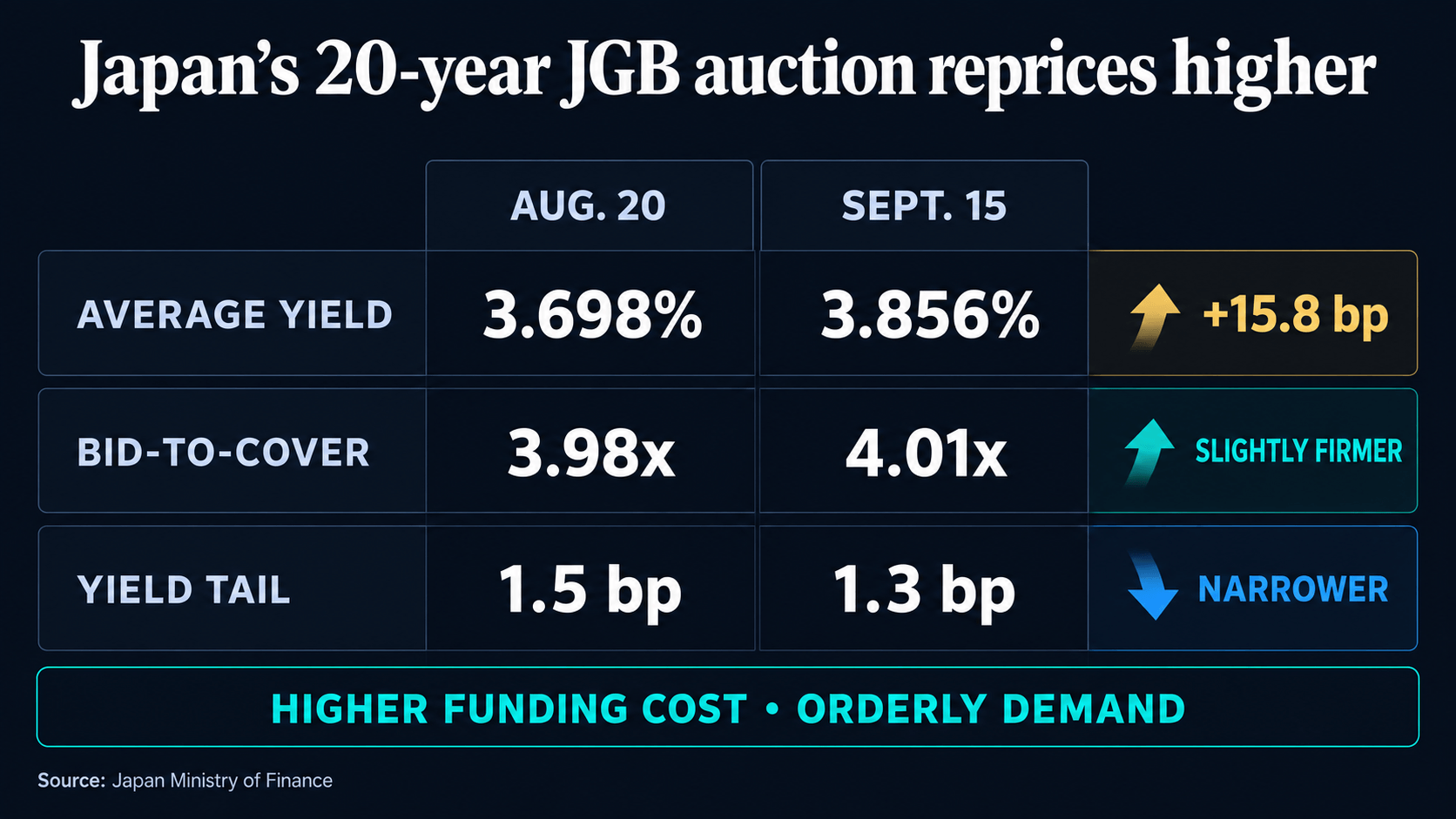 Comparison of Japan’s August and September 20-year government bond auctions, showing a higher average yield alongside slightly firmer bid coverage and a narrower yield tail.
For Bitcoin, the distinction separates an immediate stress event from a slower policy risk. Investors can borrow yen at relatively low short-term rates to finance positions in higher-returning assets. If Bank of Japan policy raises those borrowing costs or a stronger yen makes the loans more expensive to repay, leveraged positions can come under pressure.
A 20-year bond yield is not that short-term funding rate. Tuesday’s auction therefore does not show that a carry unwind has begun. It shows that investors demanded a greater return for holding long-dated Japanese debt, adding to the broader repricing that could influence BOJ policy and the yen.
Tuesday’s cross-market signals showed no clear auction shock
The available cross-market readings were also inconsistent with a clean, immediate deleveraging signal. A Reuters update published before the auction had the Nikkei modestly higher and the yen weaker against the dollar, even as global bond yields remained elevated. Contemporaneous Bitcoin snapshots placed BTC near $77,700 with a daily decline of less than 1%.
Those observations were not synchronized after the auction, so they cannot establish that the sale moved Bitcoin. A clearer carry-stress signal would require a sharp yen appreciation to coincide with weaker equities and crypto, rather than a higher long-bond yield alone.
The repricing was nevertheless notable. The Bank of Japan’s August bond-market survey put respondents’ median end-September forecast for the 20-year market yield at 3.70%, with an upper quartile of 3.75%. The auction yield is not a like-for-like measure or date, but its 3.856% average shows how far the long end has moved beyond that survey range. The survey’s headline market-functioning measure improved to -12 from -16 in May, although the improvement was not broad-based.
The BOJ’s April Financial System Report described Japan’s financial system as stable overall and resilient in stress tests, while noting rising bond valuation losses and relatively large securities losses at shinkin banks. That combination reinforces the narrower conclusion: higher yields increase pressure without proving disorder.
The next test is the BOJ’s Sept. 17–18 meeting. For Bitcoin, the actionable signal will be whether policy and currency moves turn Japan’s gradual repricing into a synchronized cross-asset adjustment.
1H Down 1.05% 24H Down 3.94% 7D Down 2.93%
30D Up 20.61% 60D Up 18.53% 90D Up 15.91%
Bitcoin is -3.94% over the past 24 hours and currently sits at rank #1 by market cap.
Market cap $1.53T
Volume (24h) $37.62B Up 38.45%
Circ. supply 20.08M
FDV $1.6T
Article context